The Method

The House of Growth: a map for your healing path.

Personal development has never had a map. Until now.

Where you are. What to work on first. What's underneath. What's above. How to know if you're actually moving — and how to spot when you've gone wandering up the trellis behind the rosebush instead of doing the work the foundation actually needs.

This is the model that makes growth visible.

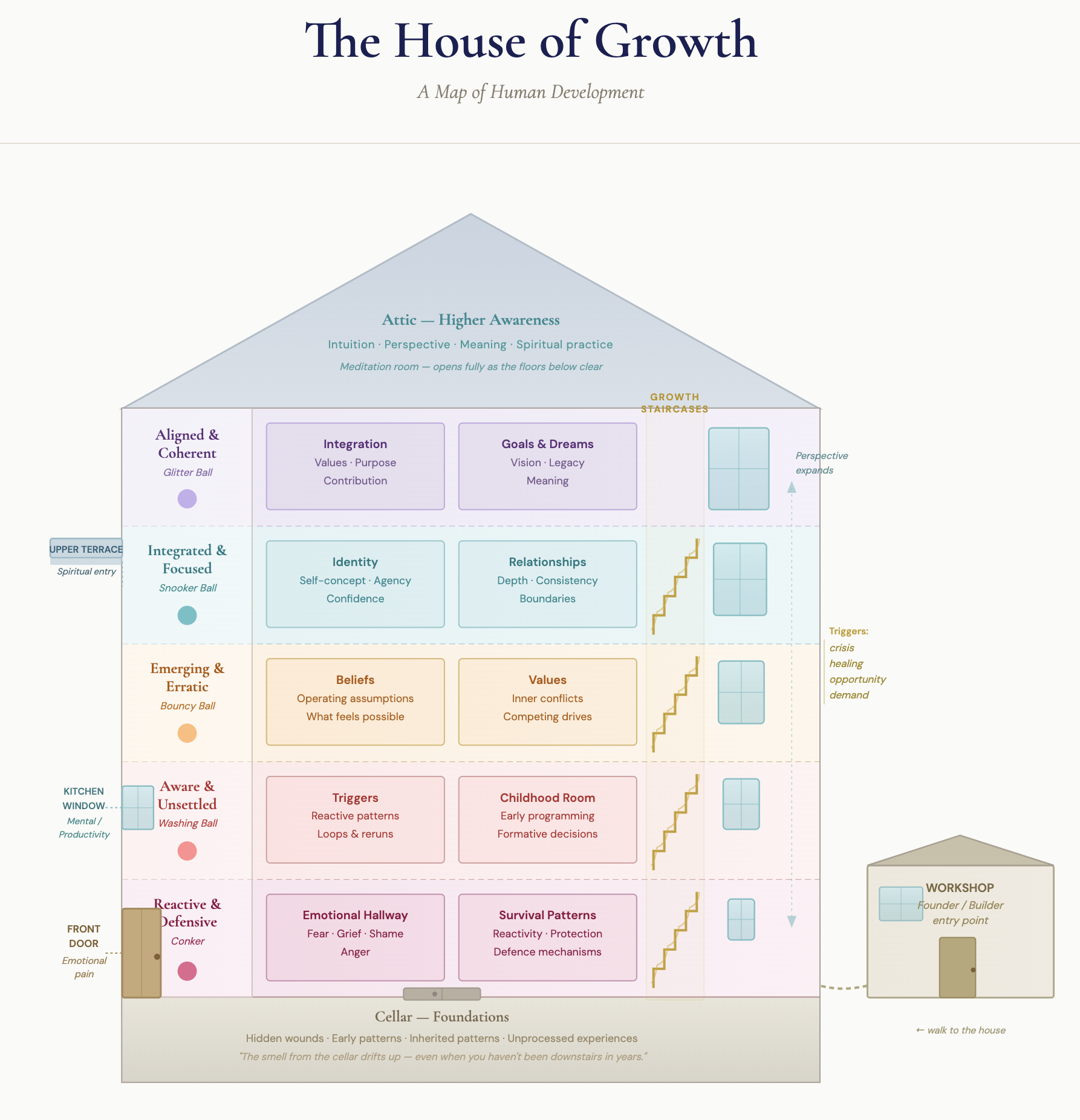
The House of Growth — illustrated map of personal development showing floors, cellar, attic, doors, and windows

The problem

The personal development industry is worth over a trillion pounds. And almost none of it can answer one simple question.

"Is it actually working?"

Not "do I feel a bit better today?" — because feeling better might just mean it's sunny. But actually, measurably, demonstrably: is the needle moving? Is your baseline shifting? Or have you been going round and round in the same comfortable patterns, spending money and calling it growth?

The sector that exists to help human beings grow has never built the tools to know whether they're growing.

The map you've never had

Every modality is a door. Nobody built the building.

Therapy is a door. Coaching is a door. Mindfulness is a door. A burnout crisis is a door. A divorce is a door. Life is excellent at creating doors.

What the industry has never built is the building behind the doors.

People arrive at therapy or coaching or a weekend retreat through whichever door pain or curiosity forced open, and they do real work. Things shift. The pressure eases. They leave feeling better. But they have no idea where they are in the broader landscape of their own development. They don't know what floor they're on. They don't know what's above them. They don't know whether the work they're doing is taking them somewhere specific or just keeping the lights on.

Without a map, you can't know where you are, where you've been, where you're going, or what to do next.

The House of Growth is the map.

Imagine a house

Not a starter flat. Something grand and old and full of potential.

An English country house with a long gravel driveway, ivy-covered walls, and a sweeping staircase inside. Floors above you. A cellar below. Rooms for every part of life. Windows on every floor. More than one way in.

This is the House of Growth. And every person alive is somewhere inside it — whether they know it or not.

The house isn't a metaphor for any single part of the development process. It's a metaphor for the whole territory of human growth.

The doors

How people enter.

Nobody starts inner work on a quiet Tuesday afternoon when everything is fine. You get pushed. The door you come through tells you where you started — it doesn't define what's ahead.

Door 1

The Front Door

Emotional pain has finally become too loud to ignore.

Anxiety is high, sleep is gone, the inner noise is relentless. Opens directly into the emotional hallway — fear, grief, shame, anger, unresolved conflict. The most direct route in.

Door 2

The Kitchen Window

For people allergic to the front door.

They don't want to talk about feelings. They want to fix brain fog, stop procrastinating, get traction. So they come in round the back — productivity, habits, mental performance. It works for a while. Then they realise the mental clutter isn't mental. It's emotional.

Door 3

The Upper Terrace

The spiritual entry point.

Some people reach for meaning, meditation, energy work, or higher consciousness before they've done much work on the floors below. Their usual arrival is climbing the trellis behind the rosebush. Dicey at best.

Door 4

The Workshop

For builders.

Entrepreneurs, artists, performers, makers — people so absorbed in creating something that the inner work sneaks up on them sideways. They're not looking for growth. They're looking for the next thing to build. But at some point, the thing they're building stops cooperating.

The rooms

Where the work happens.

Once inside the house, you start to notice the rooms. Each one holds a different aspect of the inner work. Most people are very developed in some rooms and haven't opened the door of others in years.

The Childhood Room

Early programming, patterns laid down before you had vocabulary to question them. Where childhood wound work lives.

The Beliefs Room

The operating system. Assumptions you've never examined. Stories about what's possible, what you deserve, who you are. Many feel like facts, not beliefs.

The Values Room

Where the inner conflicts argue. When the right decision keeps being impossible, two values are in opposition and neither has been examined closely enough.

The Triggers Room

Same stories on a loop. You know the pattern. You can describe it. You can't stop it.

The Repeats and Reruns Room

Unresolved material rehearsed endlessly. Awareness matters up to a point. The room has a door for a reason.

The Goals and Dreams Room

The most underused space. Most people feel guilty being there when other rooms are in disorder. That's a mistake.

Below and above

Below the ground floor and above the bedrooms.

Below — The Cellar

Every house has a cellar. Most people don't go down there voluntarily.

The cellar is where the oldest, deepest material lives — stuff that was shoved downstairs before you had language for it, inherited patterns that arrived before you were born, experiences your mind filed away because the ground floor felt too full to process them at the time.

Cellars don't stay quiet. The smell drifts up. Persistent low-level anxiety with no obvious source. A pattern of relationship breakdown that defies explanation. Recurring sabotage at the moment things start to go well. At some point, you have to go downstairs.

This is where Absolute Healing goes.

Above — The Attic

Past the main floors, at the top of the house, is the attic.

Where the spiritual practices live — meditation, contemplative work, the development of intuition, the quiet knowing.

The attic is always there. But it opens up more fully as the lower floors become clearer. You can't hear the quiet well when the rooms below are still loud.

This is one of the most useful things the model gives you: a way to understand why your meditation practice keeps failing, or why the spiritual experiences you crave feel like they belong to someone else's life.

The floors and the windows

Higher floors don't just mean more work. They mean you can see more of reality.

The house rises through floors. Each one is a deeper level of consciousness, and the work changes character entirely as you move up. Higher floors mean wider windows. The windows are the proof of the work.

Lower floors — clearing

The work is removing what's obstructing. Building the basic stability that lets you function without being at the mercy of your own reactivity. View is limited — your own pain, your own needs, the people closest to you.

Middle floors — building

The work shifts toward capability, identity, purpose. You start to author your life rather than just live it. Windows get bigger. You see patterns you couldn't see before.

Upper floors — contribution and integration

The questions get bigger. Concerns are no longer primarily personal. You understand other people's perspectives without losing your own. You make connections between things that seemed unrelated from lower down.

"Growth isn't just about feeling better. It's about becoming someone who can see and respond to reality more completely."

The staircases

What actually moves you between floors.

The floors don't change on their own. Something has to move you between them.

The staircases are the growth triggers — the experiences, processes, and practices that actually shift your level of consciousness rather than just making you feel better within the same level.

Not all inner work is a staircase. Some of it is maintenance. Some of it is repair. Both are legitimate. A house needs maintenance. But maintenance keeps you where you are.

Staircases take you somewhere new.

"Maintenance keeps you where you are. Staircases take you somewhere new."

The House of Growth gives you a way to ask the question most personal development never answers: Is this a staircase, or is this a tidy-up?

The ladder inside the house

Five stages on the path. Where are you?

Growth doesn't happen continuously. It moves through distinct stages, each with its own character. Five stages. Five balls. The physical properties of each describe what the stage actually feels like from the inside.

The Conker

Reactive and Defensive

Spiky shell, hard inside. Unprocessed pain, unresolved experience. The spikes do their job. They also collect everything nearby.

The Washing Ball

Aware and Unsettled

The spiky density softens. Real awareness developing. Real work happening. But the same loops, the same situations, the same dynamics cycling through again and again.

The Bouncy Ball

Emerging and Erratic

Energy arrives. Lighter, more dynamic, quicker to move. But unpredictable. Bounces in unexpected directions. Real growth, but not yet consistently directed.

The Snooker Ball

Integrated and Focused

Smooth, dense, precisely weighted. Genuine internal stability. Decisions come from values rather than wounds. But the pockets are still there.

The Glitter Ball

Aligned and Coherent

A Glitter Ball doesn't produce its own light. It reflects light, in all directions, simultaneously, to everyone in the room. People are drawn to it for what it does with what's already there.

Map your own house

The Head Trash Map is the free tool I built to help you locate yourself in the house.

It surfaces where your emotional weight is concentrated, which rooms need the most attention, and where the next layer of work would have the biggest impact.

Get the free Head Trash Map →

The order of operations

Foundation, then floors, then attic. Always.

The house has an order. The cellar before the attic. The ground floor before the terrace. The foundation before the upper rooms. This isn't a moral law. It's a structural one. You can't sustain elevation without foundation. The floorboards wobble.

And yet, an enormous number of people start at the attic. They reach for meditation, energy work, plant medicine, breathwork, the higher dimensions — sometimes because they've been told that's where the answer is, sometimes because the lower floors feel too painful to enter, sometimes because the spiritual world seems more glamorous than the cellar.

This has a name now. Spiritual bypassing. And it's one of the most common patterns I see in people who've been "doing the work" for years but feel quietly puzzled about why nothing has fundamentally shifted.

You go to a retreat. You feel transcendent for three days. You come back, and within a fortnight, you're snapping at your partner about the dishwasher. The same triggers fire. The same wounds activate. The same patterns run.

"The trellis just wasn't a staircase."

The retreat didn't fail you. There was no foundation to receive what you experienced, so you couldn't keep it.

You can't sustain elevation without foundation. The floorboards wobble.

Why HTC works everywhere

Head Trash Clearance is the practice that moves you through the whole house.

Most people misunderstand what HTC is for, even some who've been working with it for years. So this is worth saying clearly.

HTC isn't only for wounds. It isn't only for trauma. It isn't only for clearing the cellar. It's the practice that lets you do any kind of work in this house, at any level.

Ground floor

HTC clears the room you're in. Anxiety in the emotional hallway. Beliefs in the beliefs room. Conflicts in the values room. Triggers in the triggers room.

Cellar

HTC pairs with Absolute Healing to go after the structural material — wounds, inherited patterns, pre-verbal imprints.

Upper floors

Where the work shifts toward contribution and integration, HTC keeps clearing what gets in the way of that. The fears that come up around stepping into bigger rooms. The blocks that surface specifically when you're closest to a breakthrough.

Attic

Spiritual experiences become available at higher floors but aren't always met cleanly. HTC clears what surfaces from deep meditative states.

It's not a beginner's tool. It's a navigational tool that scales with where you are. That's why I built it the way I did. It had to work at every level — because the house needs that.

Read more about Head Trash Clearance →

Where measurement comes in

The map shows you the territory. The instrument tells you where you are.

The House of Growth tells you what the territory is. The rooms, the floors, the cellar, the attic, the order of operations, the kind of work needed at each level. It's the map.

What it doesn't do, on its own, is tell you exactly where on the map you are right now. That's the question the Ladder of Growth is built to answer — the measurement framework I co-developed precisely to fill this gap.

The map

House of Growth

Names the territory — the rooms, the floors, the cellar, the attic, the order of operations.

The instrument

Ladder of Growth

Locates you on the map. Which floor, which stage, what's moving. ladderofgrowth.io

The practice

Head Trash Clearance

The doing. Clearing rooms, going into the cellar, moving up the floors. The Club, programmes, and 1:1 work.

"Together — the map, the instrument, and the practice — make something possible that hasn't been before: the ability to see the work working."

For the full thinking

The deeper read lives in the long-form piece.

This page is the visual manifesto. The full white paper version — every section expanded, every implication thought through — is the long-form blog companion.

Read the full piece →

~20 min read · The long-form companion

Start navigating

Three routes, depending on where you are.

If you're ready to start navigating the house with intent rather than wandering between doors, here's where to begin.

Map your house first

The Head Trash Map

Free

Identify where your emotional weight is concentrated and which rooms need the most attention. The starting point.

Daily practice

The Clearance Club

£49/month

Guided audio clearances and ongoing practice. The home base for sustained navigation through the house.

Deep climb

The Ascent

£5,777

Three months of structured deep clearing with calibration measurement at every stage. The deliberate climb up the floors with the data to prove it.