Method developed and refined since 2010 across 1,000+ clearance sessions.
This is a case study in glass child healing – what becomes possible when the foundational wounds of being the invisible child finally get the structural work they need. Rachel had years of therapy behind her — and her floor, the level she dropped to when life hit hardest, was still at 159. Five months of glass child healing later, her floor was at 363.
There’s a moment I want to tell you about.
Near the end of a programme – last few sessions, work wrapping up – a client I’ll call Rachel was talking about something that had happened in her family. Something heavy. The kind of thing that, when she’d tried to speak about it before, would pull her completely under. She couldn’t get through a sentence without breaking down. The emotional weight of it was total.
This time, she got through it.
Not without feeling. There was sadness – real, quiet sadness. She paused, sat with it for a moment. And then she kept going.
The weight that had made it unspeakable wasn’t there anymore. The sadness was still there, and it should be – some things deserve to be grieved, always. But the thing that had been collapsing her every time she tried to carry it had gone.
That’s what a rising floor looks like in a real human life. Not the absence of pain. The ability to hold it without going under.
Rachel’s family history includes two suicides of people close to her. She has been in therapy for years – serious, long-term therapeutic work, the kind that British people don’t undertake lightly. She came to me having done an enormous amount of the inner work already.
And her floor was still at 159.
In this post:
The glass child
Rachel introduced me to a concept I’d never heard before. She called herself a glass child.
A glass child is what happens when there’s a disabled sibling in the family – and all of the family’s attention, energy, and emotional resource flows toward that sibling. The other child becomes transparent. Seen through, not seen. Present but invisible. Their needs, their pain, their ordinary childhood – all of it receding into the background because the immediate demands of the disabled sibling are so consuming.
Glass children grow up with their own wound clusters around this. The invisibility. The sense that their needs don’t count. The learned smallness of taking up as little space as possible so as not to add to the family’s burden. They become extraordinarily self-sufficient – because they had to be – and extraordinarily lonely, because self-sufficiency at that level is just isolation with better coping mechanisms.
Rachel had been working on this in therapy for years. She understood it thoroughly. She could map it, name it, trace it back. And it was still running.
Her floor was 159. When things got hard – and things in her life had gotten very hard, multiple times – that’s where she dropped to. Deep in the contracted states. Fear, grief, the world feeling fundamentally unsafe.
She came to me for the foundation work. Not business work – purely personal. We used the lens of her heaviest, darkest, most foundational wounds: the glass child material, the family history, the things in the basement that had been quietly setting the ceiling on everything built above them. This is what glass child healing actually targets – not surface coping mechanisms, but the structural material underneath.
Weekly sessions. No business agenda. Just the person and what she was carrying.
The data

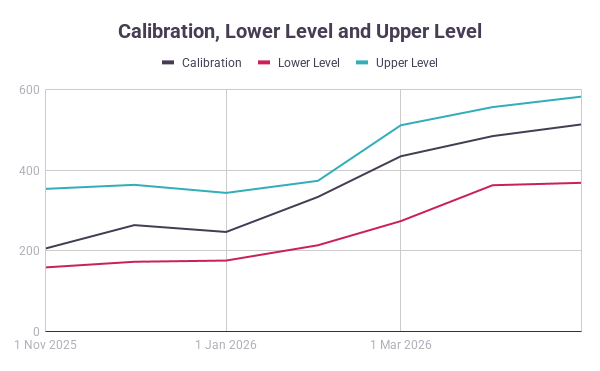
Nov 2025: baseline 206, floor 159, ceiling 354
Dec 2025: baseline 264, floor 173, ceiling 364
Jan 2026: baseline 247, floor 176, ceiling 344
Feb 2026: baseline 334, floor 214, ceiling 374
Mar 2026: baseline 435, floor 274, ceiling 512
Apr 2026: baseline 485, floor 363, ceiling 557
Notice January – the dip from 264 back to 247. Something surfaced that month. A layer that needed clearing before things could keep moving. That’s what the dip always means. It’s not regression. It’s the work going deeper.
And then February: 334. March: 435. April: 485.
The energetic makeup chart tells the story even more visibly. She started with 38% Conker energy – the reactive, defended, survival-mode energy that sets the floor and narrows the range. By April: 3% Conker. She also went from 0% Glitter Ball to 23%.
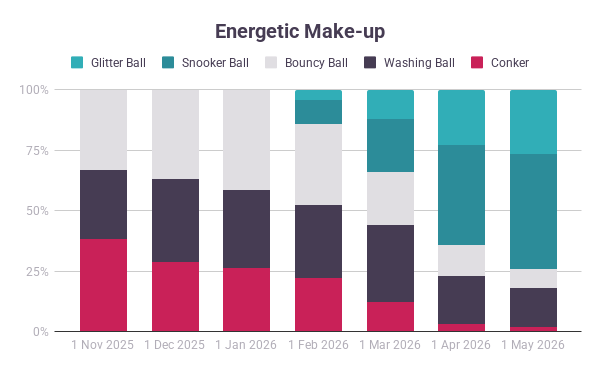
That’s not a number changing. That’s the internal composition of a person changing.
Start: 206. End: 485. That’s +279 points in five months.
Floor: 159 to 363. That’s +204 points.
Hawkins says five points in a lifetime.
She moved 279 in five months. Her floor moved 204.
What 204 floor points means
I want to stay with the floor for a moment, because it’s the number that matters most in Rachel’s story.
159 is very deep in the contracted territory. Below 200, the world feels threatening at a cellular level. The self feels fundamentally unsafe. Two suicides of close family members. Years of being the invisible child. The accumulated weight of a life that has asked a great deal of her, quietly, without much acknowledgement.
That weight doesn’t just affect how you feel. It affects what you can hold. What you can speak about. Whether you can sit in a room with a difficult memory and stay present, or whether you get pulled under every time.
363 is above the threshold where contracted states dominate. It’s not Glitter Ball. But it’s a floor where you can carry hard things without collapsing under them. Where you can talk about the unsurvivable things – two suicides, family losses, the long invisible childhood – with sadness, but not with devastation. Where the worst days are genuinely less extreme, not because the hard things didn’t happen, but because the foundation holding you up is stronger.
That’s what we built. Not happiness. Not the erasure of grief. A foundation strong enough to hold what her life has required her to carry. That’s what glass child healing makes possible.
The moment near the end
I said at the beginning I wanted to tell you about a moment.
Near the end of the programme, Rachel was talking about her family. About the suicides. About the things that had happened that can’t be undone. And she got through it. Sat with the sadness. Kept going.
Afterwards she said something I keep coming back to.
She said the heaviness was gone. The sadness was still there – she didn’t want to lose the sadness, because the sadness honours what was real. But the thing that had been making it impossible to carry, impossible to speak, impossible to sit with – that had gone.
That’s the distinction I want you to hold. Grief isn’t the problem. Grief is appropriate. It’s human. The problem is when grief becomes a weight that makes functioning impossible – when the floor is so low that any contact with a hard memory sends you under.
When the floor rises, grief becomes something you can hold. Carry. Honour. Without drowning.
She’s not done. There’s more work available to her – there always is, at any level. But she’s in a fundamentally different position now than she was five months ago. The basement is clearer. The foundation is stronger. And the ceiling – the invisible limit on what she can build above it – has moved.
Why glass child healing reaches what therapy can’t
Rachel had years of therapy behind her when she came to me. Insightful, careful, well-trained therapy. She understood the glass child material intimately. She could narrate her own internal life with precision.
And the floor was still at 159.
Therapy is exceptional at building insight – the architecture of the wound. The story of where it came from. The patterns it generates. Absolute Healing works on the layer underneath: the wound itself. The structural material that keeps regenerating the patterns no matter how much insight you build around them.
Insight rises the ceiling – what you understand, what you can articulate, what you can see clearly on a good day. The wound work rises the floor. And when the floor rises, the floor stays risen. It doesn’t drop back when you’re triggered. It doesn’t collapse when something hard happens. The composition of the person has changed.
That’s what Rachel got. Not a better story about her family. A floor that holds.
The piece this series has been building toward
Every story in my case studies is a different version of the same thing.
Laila moved 386 points and got the private jet and the £300k job and the equanimity to hold her husband’s death.
Hanna moved 227 points and found £100k growing in trees at the bottom of her garden.
Kat moved 246 points in two months and cleared a shame that wasn’t even hers – carried from her birth mother’s wound before Kat was old enough to have words.
Alex moved 109 points and her revenue projection jumped £650k.
And Rachel moved 279 points – floor from 159 to 363 – and can now speak about the hardest things in her life without being pulled under.
Different entry points. Different presenting problems. Different data.
Same question underneath all of it: is it actually working?
Yes. I have the charts.
And I’m done keeping them to myself.
If Rachel’s story resonates
If you’re reading this and recognising yourself – whether in the glass child healing aspect, the family loss, or just the experience of having done years of inner work and feeling like the foundation underneath you is still too thin to hold what your life is asking you to carry – this is the work that builds the floor.
There are a few ways to take it further:
- The Foundation (£7,777) – my deepest 1:1 programme. Structural work on the heaviest, most foundational wounds. The right fit if you’ve done significant work already and you want what’s underneath all of it cleared.
- Heal Your Hidden Wounds (£4,750) – 1:1 wound healing. Three months. The right fit if you know there’s structural material underneath your patterns and you want it cleared properly.
- Heal Your Glass Child Wounds (£495) – self-paced wound programme specifically for the glass child material. The right entry point if 1:1 isn’t where you want to start, or if the glass child work is the specific cluster you want to address.
- The Emotional Architecture Scan (£1,650) – a one-off diagnostic. I map your internal architecture and tell you what’s setting your floor before you commit to anything bigger.
If you’re not sure where to start, the free Head Trash Quiz identifies where your emotional weight is concentrated and points you in the right direction.
By Alexia Leachman · Method developed and refined since 2010 across 1,000+ clearance sessions
About the author: Alexia Leachman is the developer of the Head Trash Clearance Method and creator of Ladder of Growth – the consciousness measurement framework that maps where someone is on the path of becoming. Her wound healing work goes after the structural material underneath, including the ancestral and in-utero layers. More about Alexia
Head Trash Clearance is not therapy and is not a replacement for clinical mental health support. If you’re in crisis, please reach out to a qualified professional.
Read next: