

Method developed and refined since 2010 across 1,000+ clearance sessions.
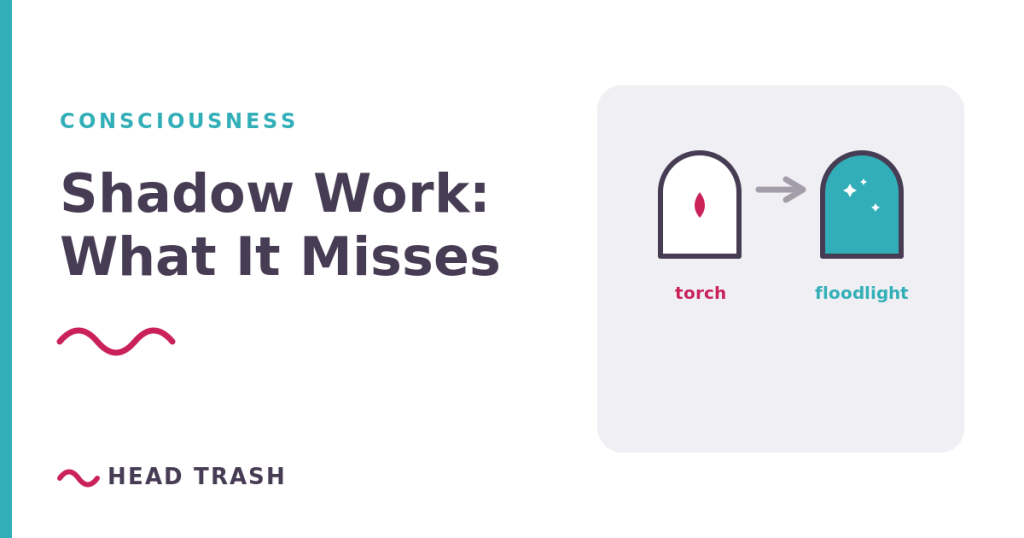
Shadow work is one of the bravest things in the personal-growth world, and one of the most misunderstood. It asks you to turn and look at the parts of yourself you’ve spent a lifetime disowning – and that takes guts. But I want to be honest with you about something most articles on the topic won’t say: seeing your shadow and clearing it are two completely different jobs. One is a torch. The other is a floodlight.
Let me explain what shadow work actually is, how to start, and where it quietly hits a ceiling – because once you understand that, you’ll know exactly what to do with what it digs up.
In this post:
What shadow work is
The “shadow” is a term from Carl Jung. It’s the bundle of things about yourself you’ve pushed out of sight because, somewhere along the way, you learned they weren’t acceptable: your anger, your neediness, your envy, your ambition, the bits that got you in trouble as a child. They don’t disappear when you disown them. They go underground and run the show from there – leaking out as triggers, projections, and the patterns you can’t explain.
Shadow work is the practice of turning towards that material on purpose. Naming it, owning it, getting to know the parts of you you’d rather not admit to. It’s the opposite of the “good vibes only” approach, and that’s exactly why it’s valuable: it’s willing to go into the dark instead of pretending the dark isn’t there.
How to do shadow work (and some prompts to start)
If you’re new to it, journaling is the simplest way in. Set aside a quiet twenty minutes, pick one prompt that makes you slightly uncomfortable, and write without editing. The discomfort is the signal you’re in the right place. A few to start with:
- What trait in other people irritates me most – and where do I do that same thing?
- What am I most afraid people would think of me if they really knew me?
- What emotion was not allowed in my house growing up?
- When did I last feel deeply ashamed, and what did I decide about myself in that moment?
- What do I judge hardest in others – and what’s that protecting in me?
Go gently. You’re not trying to crack yourself open in one sitting. The point isn’t to wallow; it’s to bring what’s been hiding into the light so you can see it clearly. Which is exactly where the real question begins.
Why shadow work goes further than therapy
I tell a story in my book about exploring a cave, and it’s the clearest way I know to place shadow work next to everything else.
Picture your psyche as a vast, echoey cave. You invite your friend Therapy to explore it with you, and Therapy turns up carrying a single candle. Not a lantern. A candle. You find one rock formation, Therapy holds the flame close, and you spend the whole hour analysing how that one rock makes you feel. Interesting. But it’s a big cave, and it’s a small flame.
On the way out you pass Mindfulness, sitting serenely on a foam pad at the entrance. She’s not going into the cave at all. She’s having a very intentional sit just outside it, noticing her breath. Lovely, calming – and not actually exploring anything.
Then you remember your friend Shadow. Shadow turns up with a flaming torch straight out of Indiana Jones, and suddenly the cave looks completely different. You can see shapes, alcoves, crevices you’d have walked straight past. You learn a lot. It’s dramatic and genuinely illuminating. This is the real gift of shadow work: it brings actual fire into the dark, and shows you things the candle never could.
What the torch can’t do
Here’s the bit nobody warns you about. In the cave, by torchlight, you also nearly come a cropper twice – once when you disturb a nest of bats, and once when you slip into a freezing pool that wasn’t in the brochure.
That’s shadow work too. The torch shows you what’s there, but it doesn’t make the cave safe, and it doesn’t give you a way to deal with what you find. People ask whether shadow work is dangerous, and this is the honest answer: it’s not the looking that’s risky, it’s being flooded with difficult material and having no way to discharge it. You can spend months journaling your way into your deepest wounds and end up knowing them in forensic detail – and still get just as triggered by them on a Tuesday afternoon.
Because awareness isn’t the same as release. Seeing the shadow clearly is a real step. But understanding a pattern has never once, on its own, removed the charge underneath it. (This is the same ceiling talk therapy hits, for the same reason.)
Seeing isn’t clearing
Back to the cave. After Candle, Teacher and Torch, one more person turns up: a no-nonsense caver hauling a wheeled bag of equipment. She assembles a stadium floodlight, wheels it to the mouth of the cave, flicks the switch – and the whole thing explodes into brilliance. Every crevice, every dark shape, every forgotten relic, visible at once. The creepy shapes that loomed in the torchlight turn out to be ordinary rocks. The “danger” was just uneven ground and poorly stored memories.
That floodlight is Head Trash Clearance. Therapy brings a candle. Mindfulness sits calmly at the entrance. Shadow work brings the flaming torch. Head Trash brings the floodlight – and once the whole system is lit, you can finally clear it, because you can’t clear what you can’t see.
And clearing is the part shadow work is missing. Once the charge is drained out of a pattern, there’s nothing left to integrate, manage, or keep bravely facing. The shadow doesn’t need to be befriended forever; it needs the emotional charge taken out of it. That’s what clearing does, and for the deepest, oldest material it’s what the wound healing work is built for – the stuff that formed back in childhood, long before you had words for any of it.
Want to know what your shadow’s actually made of?
Before you go cave-diving, it helps to know where the charge is concentrated. The free Head Trash Quiz tells you where most of your head trash is hiding.
Take the free Head Trash Quiz →
How to use it well
None of this makes shadow work wrong. It’s a genuine, courageous practice, and it does something the “love and light” crowd refuses to: it goes into the dark. If you’re doing it, good.
Just be clear about what it is and isn’t. Use shadow work to bring the disowned material into the light – to see it, name it, stop being ambushed by it. Then clear the charge so it stops running you, rather than journaling the same wound for the tenth year running. Awareness then release. The torch, then the floodlight.
What you don’t want to do is the opposite of shadow work – skip the dark entirely and bolt for the spiritual heights instead. That’s spiritual bypassing, and it leaves everything in the cave exactly where it was. Shadow work at least has the courage to go in. The only thing it’s missing is the big light – and a way to clear what the light reveals.
Where to go deeper
If shadow work has shown you what’s in the cave and you’re ready to actually clear it, here’s where to take it:
- The free Head Trash Quiz – see where most of your head trash is hiding before you go digging.
- The Clearance Club (£49/month) – guided daily clearing to drain the charge out of what surfaces.
- The Ascent (£5,777) – the deep, measured work where I clear the oldest shadow material at the root, with the Hawkins data to show it moving.
If you’re not sure where to start, the Quiz points you to the right first step.
By Alexia Leachman · Method developed and refined since 2010 across 1,000+ clearance sessions
About the author
Alexia Leachman is the developer of the Head Trash Clearance Method and creator of Ladder of Growth – the consciousness measurement framework that maps where someone is on the path of becoming. She built The Ascent, a deep clearing programme with calibration tracked at every stage. Author of four books; host of the Fear Free Childbirth podcast (2M+ downloads); trainer of HTC practitioners internationally.
Head Trash Clearance is not therapy and is not a replacement for clinical mental health support. Shadow work can surface difficult material; if you’re struggling, please reach out to a qualified professional.
Read next: