

By Alexia Leachman, developer of the Head Trash Clearance Method. Developed and refined since 2010 across 1,000+ clearance sessions.
There’s a version of burnout that we don’t hear about enough, and it belongs to women going through fertility treatment.
It doesn’t look like collapse. She’s still going to work. She’s still doing the injections on time, still turning up for the scans, still answering the “any news?” texts with something gracious. From the outside she’s coping beautifully.
Inside, there’s nothing left in the tank.
I want to describe what that is, because once you can see it, you can do something about it. And what you do about it is not what most people assume.
The rucksack nobody empties
Think about someone doing a long walk in stages. Each stage, she packs a rucksack: the hope, the plans, the waiting, the appointments, the bracing for bad news. She walks the stage. Sometimes it ends the way she wanted and sometimes it doesn’t, and either way she comes home, puts the rucksack in the hallway, and gets on with life.
Then the next stage starts. And here’s the thing about a rucksack in the hallway: she doesn’t empty it first. She just adds this stage’s kit on top of last stage’s. Then the stage after that goes on top of both.
By stage nine she isn’t carrying one stage. She’s carrying nine, and she’s carrying them on a body that’s had years of hormones and procedures and 3am wakings, and she cannot for the life of her work out why this one feels so much heavier than the first one did.
She hasn’t got weaker. The bag got heavier. Nobody ever showed her how to empty it.
That’s IVF burnout. Not a collapse, and not the sign of weakness. The slow erosion of emotional capacity by a process that asks you to hope again, grieve again and stay positive again, on repeat, for years.
Why anxiety is the wrong target
Most of what’s offered to a woman in this position is support for her anxiety. Breathing, mindfulness, relaxation apps, a counsellor at the clinic if she’s lucky. All of it is about turning the volume down on how she feels today.
Which is fine – and helpful maybe – but it does nothing about the bag full of stuff that she’s still carrying everywhere she goes.
I had a client earlier this year. Ellie came to me preparing for her ninth round of IVF. She’s a hypnotherapist. She’d read my book, she’d been doing her own clearances, and they’d helped. In our first conversation she could barely speak without becoming tearful.
She wasn’t asking me to make IVF work. She just wanted to be able to get through it.
So capacity is what we focussed on. Not “let’s get you feeling calmer about cycle nine.” Let’s get eight cycles’ worth of accumulated weight out of the bag, so cycle nine can just be cycle nine instead of all the disappointments that came before it.
What a hypnotherapist came for
Ellie had been working on these themes for years, with her own tools. She’s good at them. What she described was a limit she’d hit: a sense that something was still in there, and no way to reach it.
“If I found the hypnosis wasn’t quite landing, like something was still there and I couldn’t figure it out, the clearance stuff was good because I didn’t have to. My unconscious didn’t have to sort of work it out.”
Those last words are the bit I’d underline. Most approaches need you, or your unconscious, to work out what the problem is before anything can shift. You have to find the memory, name the belief, trace the origin, tell the story. Head Trash Clearance doesn’t ask for any of that. You do a clearance on the thing that’s charged and the charge comes out, whether or not you ever understand where it came from.
Which is why she got to things in three weeks that she’d been circling for years with a modality she’s trained in and good at. We were simply working with a different layer.
What three weeks looked like
Three weekly sessions with me, and 36 separate pieces of work: 25 clearances and 11 wound healings. She did most of this herself, in her own time, often in the middle of the night, and messaged me afterwards with what came up. Then based on what she shared with me, I’d provide her with something else that addressed whatever it was that came up. When she did a clearance, she’d tell me how it went.
Sometimes sharing was all that was needed. Sometimes, I’d spot a connected theme or wound that we’d need to go after. All of this over messaging.
The first thing worth saying is how little of our work was about IVF.
She started with not being heard, rated it 8 out of 10, and while she was clearing it she found it included not being heard by the universe. By the end: “It doesn’t matter if I’m heard or not. It’s out of my control. I’m OK anyway.”
Then feeling misunderstood, which cracked open within minutes into something much older: people will let me down. Her own read on why she’d kept that one: “this keeps me in a comfort zone, I know this is what people will do, then I can rely on myself and I know where I stand.”
Then her womb, which she described as a blank area inside her, a place she couldn’t locate or feel. Underneath the disconnection was the fear driving it: my womb won’t work. Underneath that was one she’d been living inside without ever saying out loud: my womb is dying, which came from being 42 and hearing, for years, what happens to fertility in your forties.
That last one is the clearest example of a thing I see constantly. A fact goes in, the nervous system gets hold of it, and it comes back out as something absolute and personal. The facts about age and fertility aren’t wrong. What she was carrying wasn’t the fact. It was the sentence the fact had turned into.
By the end of that clearance it had shifted into “my womb is changing, which it always will. That’s natural.” A layer deeper: “my womb will do what it’s supposed to do.”
She was still 42. She still couldn’t control the outcome. The fear that had fused itself to those facts was gone.
And then, near the end, she realised she’d been holding back her own excitement about being pregnant, damping it down so the fall would be shorter if it didn’t happen:
“I got a sense of releasing all these stoppers in me and letting all the love, joy and excitement of being pregnant and having a baby come rushing out. I didn’t realise I’d been holding back SO much.”
The bit everyone gets stuck on
Here’s what that list tells you about the method, and it’s the thing I’d want you to take away even if you’re nowhere near fertility treatment.
Look at what she cleared. Not being heard. People will let me down. This isn’t what I expected. Being hated. Not being loved. A frustrated “for fuck’s sake” that had started coming out of her mouth a few times a day. Not being able to get back to sleep at 2.30am. Her relationship with her own body.
One of those is about IVF. The rest are about a whole life, and they’d all been sitting there getting heavier while she and everyone around her treated the problem as a fertility problem.
The method itself is easy. It’s in the book. Anyone can learn to do a clearance, and plenty of people do, on their own, without me.
The hard part is step one: knowing what to clear.
That’s where a lot of people stall. They pick the thing they arrived with, clear that, feel a bit better, and never get to the layer underneath that was generating it. Ellie found people will let me down because we followed feeling misunderstood down instead of stopping when it moved. She found my womb is dying because we followed I hate my womb down two layers instead of one.
The thing you arrive with is the doorway. The work is behind it.
What it looks like when the bag is empty
By our last session Ellie described her nervous system this way. If ten is fully alert, braced, on edge, she was at about a 2.
Before, her shoulders had been tense the whole time and she’d been using a massage gun every morning and night, plus a mental technique to push intrusive thoughts out of her head, over and over, all day. By the end she’d stopped doing all of it, because there was nothing left to manage.
That’s the difference between regulating and clearing. Regulating is the massage gun twice a day forever. Clearing is not needing it.
And then the measurement
I’ve been doing this long enough to know that a client telling me she feels better is not a reliable gauge of change, however much I believe her. This is why I built assessments.
Ellie had taken one before we started. The assessment she did was the Birth Readiness Profile. It reads fourteen dimensions and places each one on a five-rung development ladder. Most of us live somewhere in the middle and stay there for years.
She retook it at the end of the three weeks.
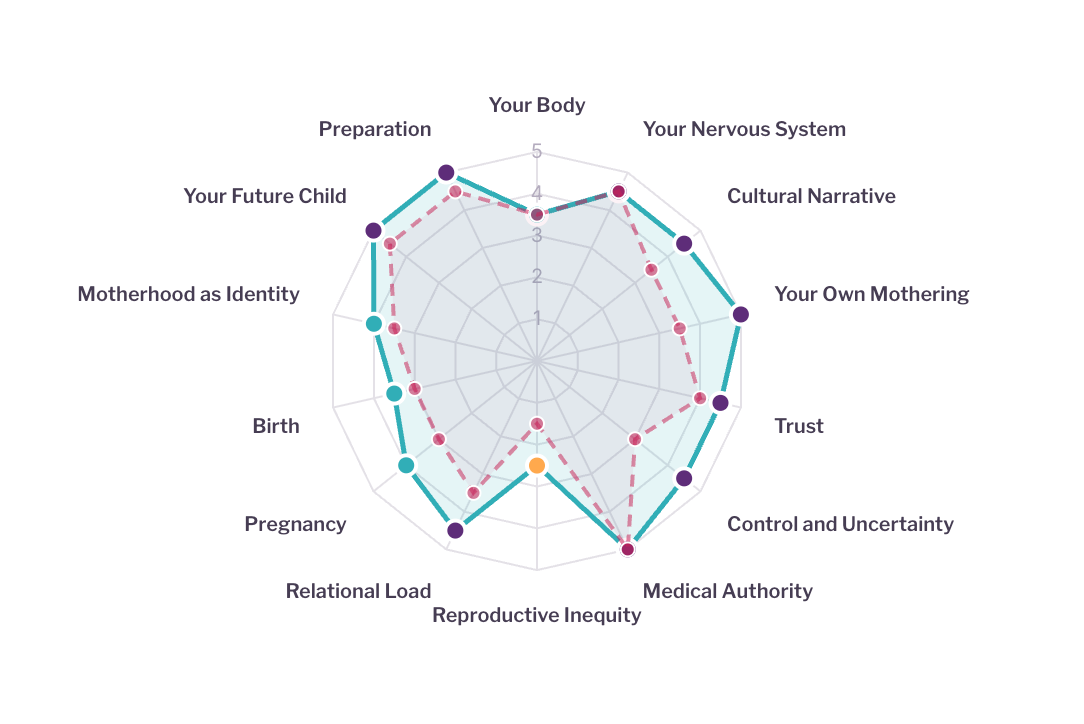
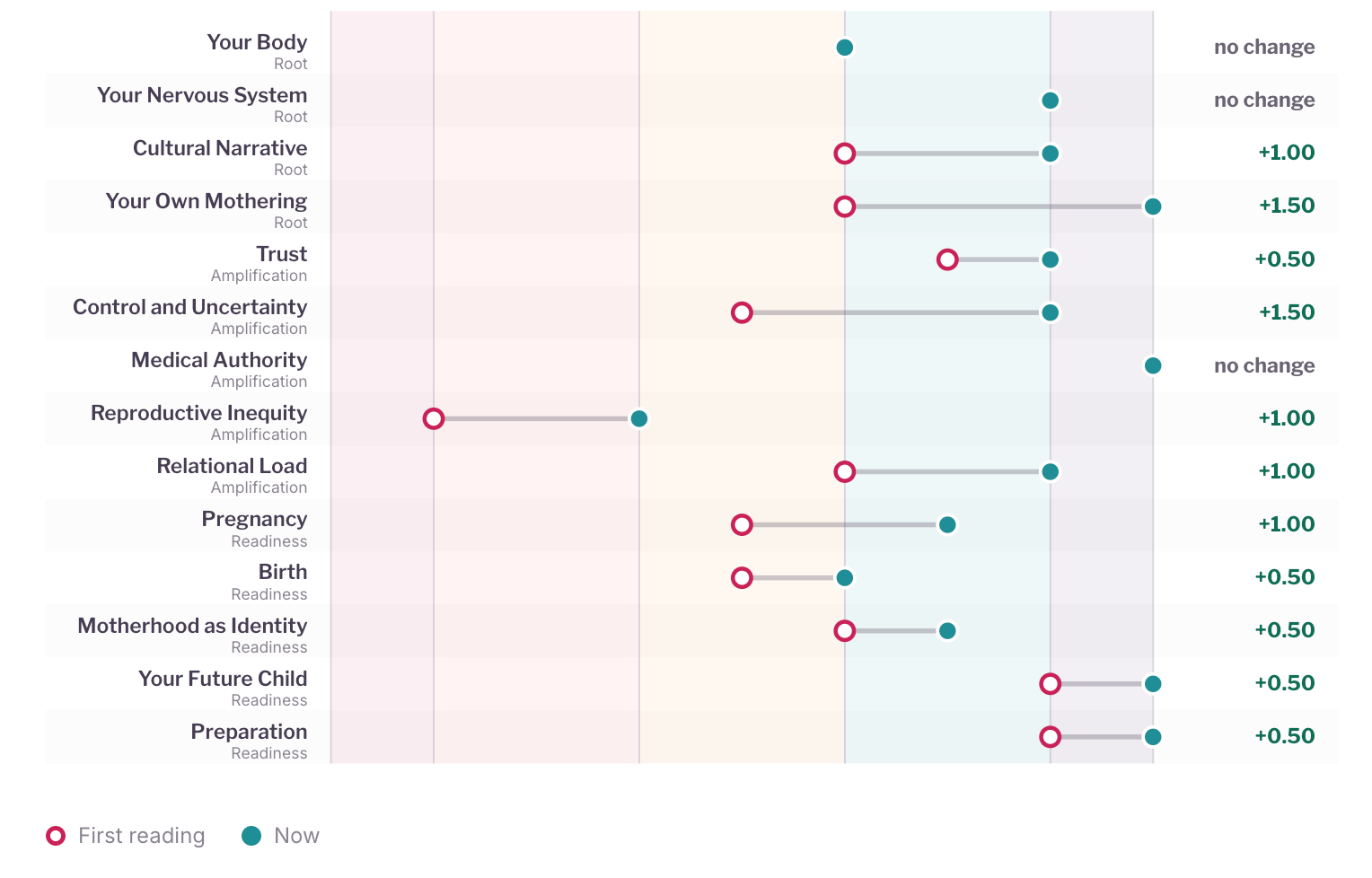
Thirteen of the fourteen dimensions moved up. The fourteenth was already at the top before we started.
Her nervous system moved a rung and a half. So did trust, which had been her lowest reading of all fourteen when she first took it, and which finished level with her strongest.
The nervous system one is the reading I care about, and not because it’s the biggest number. She told me she was at “about a 2 out of 10” in a conversation where she had no idea what the retake would show, and the assessment moved her furthest on exactly that dimension. Two completely different reads, saying the same thing.
That’s the standard I’d like more of this industry to be held to, my own work included.
Two months later, the test I couldn’t have designed
Here’s the thing about measuring someone at the end of three good weeks. Of course she feels better. She’s just had three weeks of attention and clearing and somebody paying close attention to her inner world. The question I actually care about is what happens months later when life takes a swing at her.
With Ellie I got an answer. She went through another cycle. It didn’t work.
Two things came out of that, which we can all learn from.
The first is a behaviour change during what she calls the ten day wait, the stretch after the transfer while you’re waiting for the blood test.
“Normally I’d be wanting to do an at home test or checking in with my body to notice any different ‘signs’. This time I felt calmer and no need to have to know. I got on with work, enjoyed social catch ups and let each day happen.”
Read what she’s actually describing there. Ten days of her life spent differently. Nobody coached her out of the home tests and she wasn’t white-knuckling past the urge. The compulsion to check just wasn’t generating any more, so there was nothing to resist.
The second is what happened when the answer came back and it was the wrong one.
“I feel tired and drained. There was a bit of sadness but mostly tiredness, followed by a feeling of wanting to do something which brings me joy and have a break from IVF.”
Tired. Some sadness. And then, straight away, a clear read on what she needed next. She and her partner are taking six months off to go travelling. They have a frozen embryo waiting and she’s in no rush. Her reason? She wants to restore her energy first, and go and do something awe-inspiring, so that she comes back to the next cycle connected to living rather than dragging herself to it.
People come to this work hoping it will change what happens to them. It didn’t get her a baby. What it gave her was a floor to land on when the news came. Nine cycles of accumulated weight would have turned that Monday into a catastrophe. Without it, it was a hard day followed by a sensible decision.
Another version of this would have her white-knuckling into cycle eleven because stopping feels like giving up. She’s going travelling instead, at 42, with an embryo in storage and no clock ticking at her. From choice, not from fear.
Three sessions
You might have read that Ellie had three sessions earlier and made some assumptions as to what that means. Let me explain it with numbers, and it’s to do with the way that I work – a deliberate design decision on my part rather than a happy accident.
Conventional talking therapy tends to work with roughly one issue at a time, a session a week.
Ellie had three weekly sessions with me. In the time it takes to have three therapy sessions, she did 36 separate pieces of inner work. At one piece per weekly session, that’s the best part of eight months of appointments.
The reason it compresses isn’t that I work faster in the room. It’s that the tools go home with you. She did the bulk of it herself, at 3am, between injections and scans, and sent me the notes. The resources carry the work between sessions so it compresses and results happen quickly. Not rushed. Just not dragged out.
If you’re in the middle of it
You don’t need to be told to stay positive. You have been staying positive for years and it’s costing you a fortune.
What you might need is a way to put some of it down. The hope you keep having to pick back up. The disappointment you never quite finished with. The sentence about your body you’d be embarrassed to say out loud, that has been running underneath everything since the third cycle.
None of that has to be carried into the next round with you.
If you want to start clearing on your own, the Clearance Club is where the day to day work lives. If you’re in fertility treatment right now, start with the free Reproductive Anxiety Assessment instead, so you can see what you’re actually carrying before you decide what to do about any of it.